LCD Video Wall News

LCD Display vs LED Display in 7 Key Differences

2026-01-06
Introduction: Why LCD Display Remains a Leading Choice in Modern Visual Technology

With the rapid advancement of display technology, LCD display solutions and LED display solutions have become the two most widely used visual technologies in smart cities, commercial advertising, televisions, conference rooms, control centers, and digital signage systems. Among them, the LCD display remains the core choice for most indoor applications due to its maturity, cost efficiency, stability, and excellent image performance.

When users search for LCD display vs LED display, they are often confused by marketing terms, technical specifications, and application differences. Many people mistakenly believe LED display is always superior, but in reality, LCD display technology still dominates the global display market, especially in professional digital signage, interactive displays, and commercial screens.

This article provides a comprehensive, professional, and in-depth comparison of LCD display vs LED display in 7 key differences, helping you understand why LCD display continues to be the most practical and cost-effective solution for most scenarios. This guide is especially useful for selecting displays for digital signage, education, business, retail, or smart office applications.

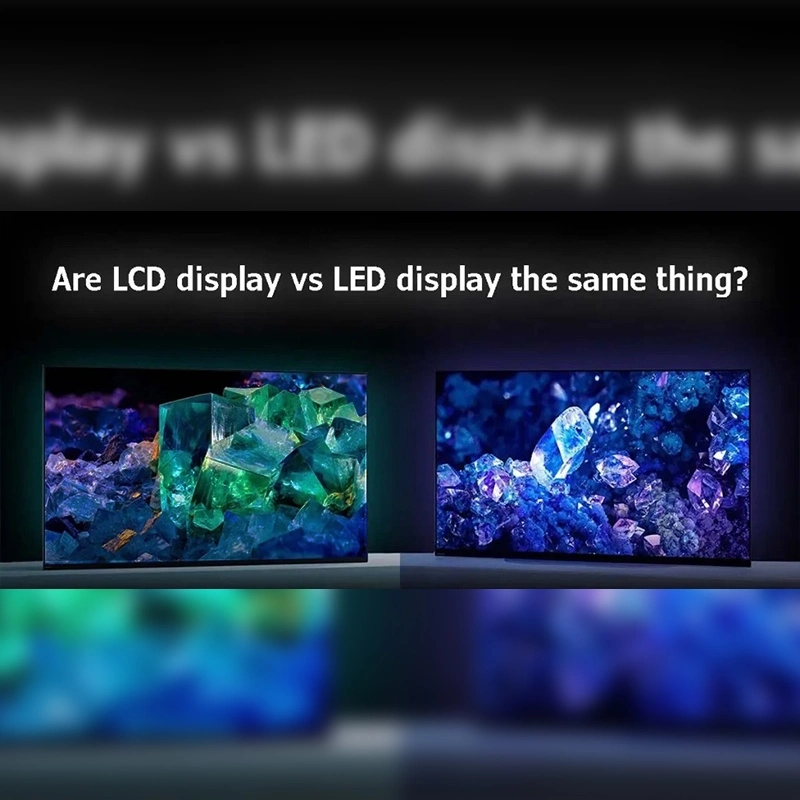
Are LCD Display vs LED Display the Same?
LCD Display vs LED Display in 7 Key Differences

Although LCD display and LED display are often compared, they are fundamentally different technologies.

An LCD display (Liquid Crystal Display) uses liquid crystal molecules to control light transmission. The LCD display itself does not emit light; instead, it relies on a backlight source to illuminate the screen. By precisely controlling the arrangement of liquid crystal molecules, the LCD display produces images, colors, and motion. Modern LCD display panels offer high resolution, sharp details, and stable color accuracy.

A LED display, on the other hand, is a self-emissive technology made of countless light-emitting diodes. Each LED pixel emits light independently, enabling extremely high brightness and strong contrast, especially for outdoor environments.

It is important to clarify a common misconception: many “LED TVs” are actually LCD displays with LED backlight. Technically, they are still LCD display products.

1. Difference in Light-Emitting Principle

The LCD display works by controlling light rather than producing it.

An LCD display uses a backlight system (such as LED backlight) behind the liquid crystal panel. When voltage is applied, the liquid crystal molecules rotate and control how much light passes through color filters to form images. This allows LCD display panels to deliver accurate colors, stable brightness, and consistent image quality.

In contrast, LED displays are composed of individual LED pixels, each emitting its own light and color, eliminating the need for a backlight layer. While this allows higher brightness, it also increases power consumption and system complexity for indoor use.

Key takeaway: LCD display technology offers precise light control and better uniformity for indoor applications.

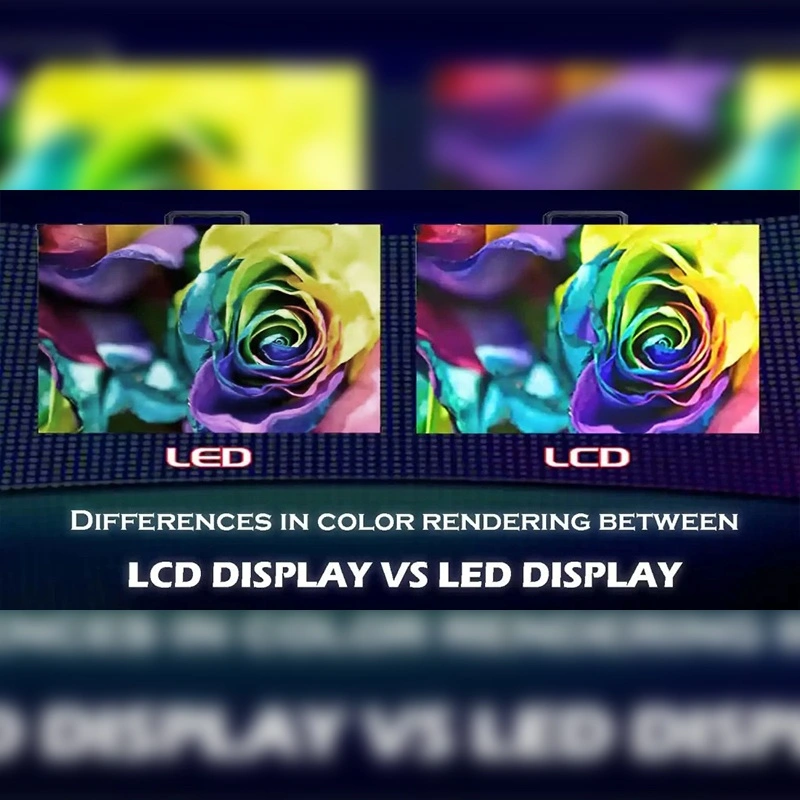
2. Differences in Color Rendering
LCD Display vs LED Display in 7 Key Differences

Color performance is a major factor when choosing between LCD display and LED display.

High-quality LCD displays use advanced panels such as IPS technology to deliver excellent color accuracy, wide color gamut, and stable color reproduction. Modern LCD display solutions support 4K resolution with vivid and realistic colors, making them ideal for advertising, education, and professional presentations.

LED displays can deliver strong visual impact due to high brightness, but color accuracy depends heavily on pixel pitch, calibration, and environment. At close viewing distances, LED displays may show graininess or color inconsistency.

For applications requiring color precision, detail clarity, and visual comfort, LCD display has a clear advantage.

3. Difference in Response Speed

Response speed affects motion clarity when displaying videos or animations.

LED displays offer extremely fast response times because each pixel emits light directly. This makes LED displays suitable for large-scale dynamic visuals, sports arenas, and outdoor billboards.

However, modern LCD display panels have significantly improved response speed. With advanced driving technology, LCD display solutions can handle high-definition video, real-time presentations, and interactive content smoothly, without noticeable motion blur.

For digital signage, conference rooms, and classrooms, LCD display response speed is more than sufficient.

4. Differences in Viewing Angles

Viewing angle performance is crucial for public and commercial displays.

Traditional LCD displays had limited viewing angles, but modern IPS LCD display technology largely solves this problem. Today’s LCD display panels can offer viewing angles up to 178°, ensuring consistent brightness and color from different positions.

LED displays naturally provide wide viewing angles, but at close distances, pixel structure may affect image smoothness.

For indoor digital signage, meeting rooms, and interactive whiteboards, LCD display provides a more comfortable and natural viewing experience.

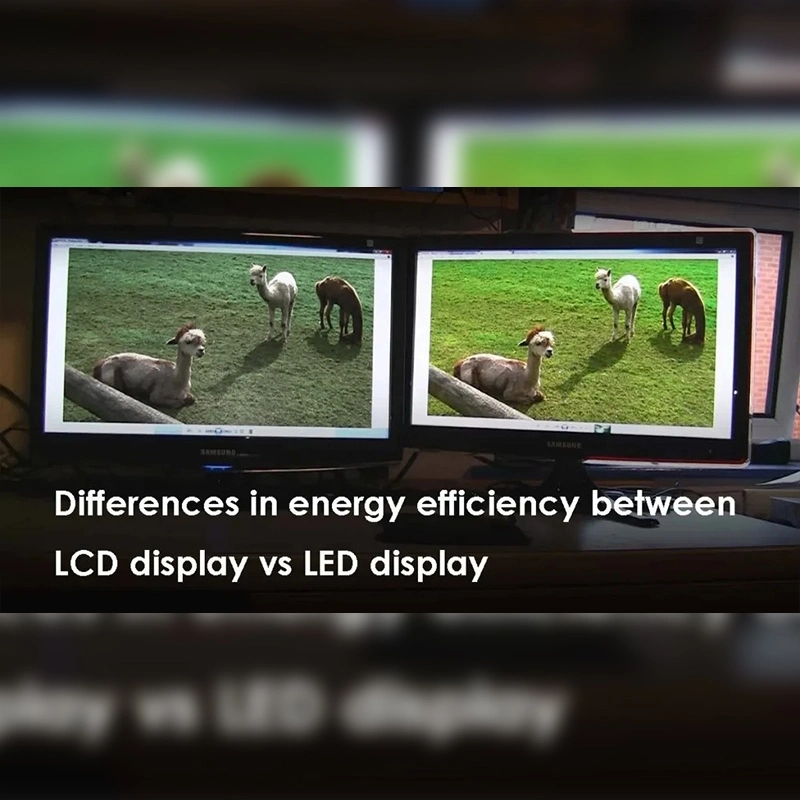
5. Differences in Energy Efficiency
LCD Display vs LED Display in 7 Key Differences

Energy efficiency directly impacts operating costs.

LCD displays consume power mainly through their backlight systems. With intelligent brightness control and energy-saving panels, modern LCD display products are highly efficient and stable for long-term operation.

LED displays consume energy based on brightness output. High-brightness LED displays, especially outdoor models, require significantly more power and generate more heat.

For indoor applications with long operating hours, LCD display solutions are more energy-efficient and economical.

6. Differences in Cost

Cost is a decisive factor for most projects.

LCD displays benefit from decades of manufacturing optimization, resulting in lower production costs, stable supply chains, and flexible size options. Large LCD display panels are widely used in video walls, digital signage, and interactive displays with excellent cost-performance ratio.

LED displays, especially fine-pitch models, are significantly more expensive. Installation, maintenance, and calibration costs are also higher.

For most commercial and professional projects, LCD display offers the best balance between price and performance.

7. Differences in Application Environments

Application environment defines the final choice.

LCD display products are ideal for:

  • Indoor digital signage
  • Conference rooms
  • Education and training
  • Retail advertising
  • Control rooms
  • Interactive whiteboards

LED displays are better suited for:

  • Outdoor advertising
  • Stadiums
  • Large public squares
  • High-brightness outdoor environments

In practical digital signage projects, LCD display remains the dominant choice worldwide.

LCD Display vs LED Display Comparison Table
LCD Display vs LED Display in 7 Key Differences
功能 LCD Display LED Display
Light Source Backlight (LED/CCFL) Self-emissive LEDs
顏色精度 High, stable High at distance, may vary close up
響應時間 Fast enough for indoor use Very fast
視角 Wide (IPS up to 178°) Wide, may show pixel structure close up
能源效率 Moderate, energy-saving panels Higher consumption at high brightness
成本 Lower, scalable Higher, especially fine-pitch
Best Environment Indoor digital signage, offices, education Outdoor, stadiums, high-brightness areas
Frequently Asked Questions (FAQ) About LCD Display
Q1: Is LCD display better than LED display for indoor advertising?
Yes. LCD display provides better color accuracy, energy efficiency, and cost-effectiveness for indoor digital signage.
Q2: Can LCD display handle 4K content?
Absolutely. Modern LCD display panels support 4K ultra-high-definition content with vivid colors and smooth motion.
Q3: Are all “LED TVs” real LED displays?
No. Most marketed “LED TVs” are actually LCD displays with LED backlight.
Q4: How long does an LCD display last compared to LED?
LCD display panels typically last 50,000+ hours, making them reliable for long-term commercial applications.
Q5: Can LCD display be used outdoors?
They can, but for direct sunlight or high-brightness environments, LED displays are preferred. LCD display is best for indoor applications.
Q6: Is maintenance easier for LCD display?
Yes. LCD display systems are simpler to maintain than fine-pitch LED displays, reducing downtime and operational costs.
Why Choose Qtenboard LCD Display Solutions?

Qtenboard provides professional LCD display solutions with advantages such as:

  • Factory-direct manufacturing
  • Multiple size options and customization
  • 4K ultra-high-definition LCD display panels
  • Long-life and energy-efficient designs
  • Stable performance for 24/7 operation
  • Professional support for digital signage projects

Whether you are building a digital signage network or upgrading your commercial displays, Qtenboard provides the most suitable LCD display solutions based on your project requirements.

結論
When comparing LCD display vs LED display, there is no absolute winner—only the most suitable solution for your application. However, for indoor environments, commercial digital signage, education, and business use, LCD display technology remains the most practical, reliable, and cost-effective choice.

By understanding these seven key differences and reviewing the FAQ and comparison table, you can confidently select the right LCD display solution to maximize visual performance and investment value. If you would like professional advice or customized LCD display solutions, Qtenboard is always ready to support your project.

單擊以閱讀產品詳細信息,並了解其功能特性和實際性能。

📖閱讀產品

首頁 Whatsapp 郵件 詢價